
Push In Wire Connectors Guide
Push-in wire connectors are popular because they make low-voltage and branch-circuit wiring work faster, cleaner, and easier to check. Instead of twisting conductors together and securing them with a wire nut, the installer strips each conductor to the specified length and pushes it into a dedicated port until it is fully seated.
That simplicity is useful, but it does not mean every push-in connector is right for every job. The right choice still depends on conductor type, wire size, voltage rating, current rating, enclosure, and local electrical code. This guide explains where push-in wire connectors work best, what to check before using them, and when another connector style may be a better option.
What are push-in wire connectors?
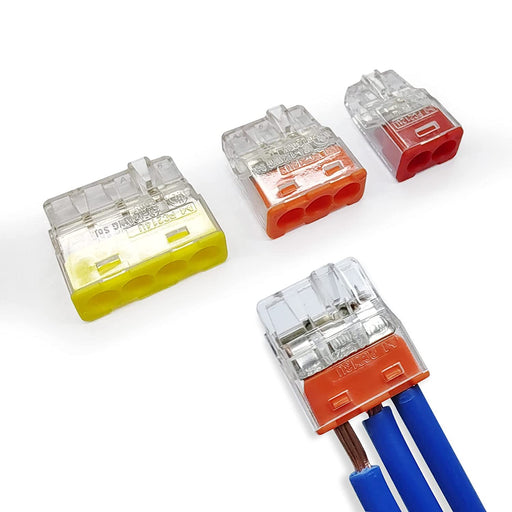
Push-in wire connectors are compact electrical connectors designed to join two or more conductors inside an approved electrical enclosure. Each wire is inserted into its own port, where an internal spring or contact mechanism holds the conductor in place and maintains electrical continuity.
They are commonly used in junction boxes, lighting fixtures, switch boxes, control panels, and repair work where space is limited and a clean connection layout matters.
For product options designed for compact wiring layouts, you can view Dicio’s inline wire connectors.
Why installers use push-in connectors
The biggest advantage of push-in connectors is ease of use. In many common applications, the process is straightforward: strip the wire to the correct length, insert it fully, and verify that it is seated. Compared with traditional twist-on wire connectors, this can make wiring tasks feel more predictable, especially when multiple conductors need to be organized inside a crowded box.
Another benefit is compactness. Push-in connectors often fit neatly into electrical boxes where wire organization matters. If you are connecting fixture leads, making pigtails, or joining several conductors in a junction box, a compact connector can make the layout easier to manage and help keep conductors from becoming a tangled bundle.
There is also a consistency benefit. With a twist-on connector, the final result depends heavily on technique, conductor combination, twist quality, and how securely the connector is installed. Push-in connectors create a more standardized process when they are used within their listed wire range and according to the manufacturer’s instructions.
Where push-in wire connectors work well
Push-in wire connectors are often a good fit for:
- Lighting fixture installations
- Junction box wiring
- Switch and outlet box pigtails
- Low-profile or crowded electrical boxes
- Maintenance and repair work
- Pre-wired assemblies or repeat wiring tasks
- Clean wire organization inside protected enclosures
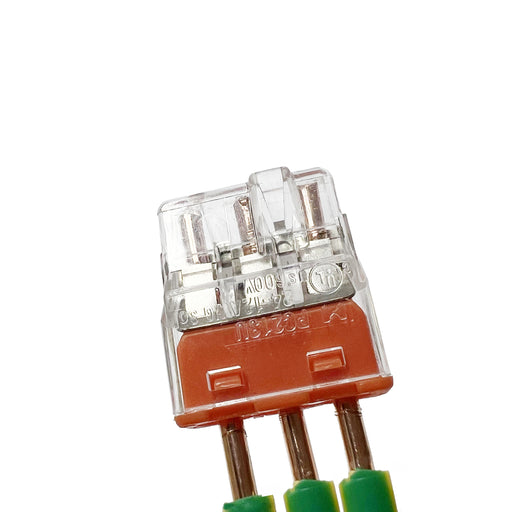
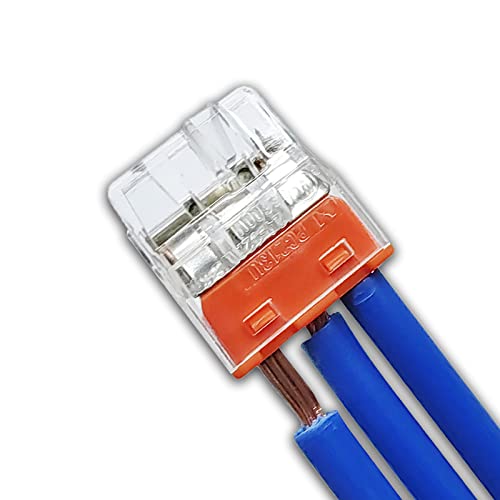
They are especially helpful when the installer needs a connection that is easy to inspect visually. Many models use transparent or semi-transparent housings, allowing the installer to confirm that the conductor has reached the correct depth.
What to check before choosing a push-in connector
Before using any wire connector, check the product markings, packaging, and instructions. A connector should be selected for the exact conductor type, wire size, and application. Do not assume that a connector works for every wire just because the wire fits into the opening.
1. Wire gauge range
Every connector has a rated wire size range. Common residential and light commercial wiring may involve 12 AWG or 14 AWG conductors, but the correct size depends on the circuit and application. Always confirm that the connector is rated for the wire gauge you are using.
2. Solid or stranded wire compatibility
Some push-in connectors are designed for solid copper conductors only. Others may also accept stranded wire, fine-stranded wire, or tin-bonded stranded wire. This detail matters because the internal contact design must be suitable for the conductor structure.
If you are working with stranded conductors, do not use a connector unless the product instructions clearly allow that conductor type.
3. Copper, aluminum, or copper-clad aluminum
Many standard push-in connectors are intended for copper conductors. Some products may be listed for other conductor materials, but this depends on the connector. Aluminum and copper-clad aluminum conductors require special attention because the connector must be specifically identified as suitable for that use.
When in doubt, stop and confirm the connector rating before making the connection.
4. Voltage and current rating
The connector must be rated for the electrical load and environment. A connector used in a lighting circuit, appliance assembly, control box, or power distribution application may have different rating requirements.
5. Enclosure and location
Wire splices should be made inside a suitable electrical enclosure. A connector should not be left loose, exposed, or unsupported outside a box or approved housing. If the job involves outdoor, damp, or wet locations, use products specifically rated for that environment.
If you are also organizing wiring through knockouts, Dicio’s knockout cable connector can help route non-metallic cable into a junction box more cleanly.
Push-in connectors vs. wire nuts
Traditional twist-on wire connectors, often called wire nuts, are still widely used and can be a good choice when installed correctly. Push-in connectors are not automatically better in every situation. The better option depends on the application, conductor type, installer preference, and required listing.
| Feature | Push-in wire connectors | Twist-on wire connectors |
|---|---|---|
| Installation style | Strip and insert each conductor into a port | Twist conductors together with the connector |
| Consistency | More standardized when used within rating | More dependent on installer technique |
| Box organization | Compact and orderly | Can take more space in crowded boxes |
| Inspection | Some models allow visual confirmation | Connection is mostly hidden inside the cap |
| Flexibility | Limited by port count and wire rating | Available in many sizes and combinations |
Common mistakes to avoid
Using the wrong strip length
Push-in connectors usually require a specific strip length. If the stripped section is too short, the conductor may not seat properly. If it is too long, exposed copper may remain outside the connector. Use the strip gauge printed on the connector or included in the product instructions.
Mixing conductor types without checking the rating
Do not assume that one connector can handle every combination of solid, stranded, copper, aluminum, or copper-clad aluminum conductors. The connector must be marked or documented for the conductor combination being used.
Using damaged or oxidized wire
A connector can only perform properly when the conductor surface is suitable for connection. Damaged, nicked, heavily oxidized, or contaminated conductors should be addressed before installation.
Overfilling an electrical box
A compact connector can help with organization, but it does not remove box-fill requirements. Make sure the electrical box has enough capacity for the number and size of conductors, devices, clamps, and connectors inside.
Leaving splices outside an enclosure
Push-in connectors should be used in suitable protected enclosures unless the product and installation method specifically allow otherwise. Exposed splices can create shock, fire, or mechanical damage risks.
How to install push-in wire connectors
The exact steps may vary by product, so always follow the manufacturer’s instructions. In general, the process looks like this:
- Turn off power to the circuit.
- Verify that power is off with an appropriate tester.
- Confirm that the connector is rated for the wire type, wire size, voltage, and application.
- Strip each conductor to the specified length.
- Inspect the conductor for damage, corrosion, or loose strands.
- Insert each wire fully into the correct port.
- Gently tug each conductor to confirm that it is seated.
- Place the connection inside an approved electrical enclosure.
- Arrange the wires so there is no unnecessary strain on the connection.
- Restore power only after the box, cover, and wiring are properly secured.
Are push-in wire connectors safe?
Push-in wire connectors can be safe when they are properly listed, correctly selected, and installed according to the product instructions and applicable electrical code. The important point is not the connector style alone, but whether the connector is suitable for the conductors and conditions of use.
For any electrical installation, follow local code requirements and consult a licensed electrician when the application involves service equipment, aluminum conductors, wet locations, high-load circuits, or any wiring condition you are not qualified to evaluate.
When not to use a standard push-in connector
A standard push-in connector may not be the right choice if:
- The wire type is not listed for that connector
- The wire gauge is outside the rated range
- The application involves wet or outdoor conditions without the proper rating
- The circuit requires a connector listed for a special use
- The conductors are damaged, corroded, or poorly stripped
- The splice cannot be placed inside an approved enclosure
- The installation must comply with special local or project-specific requirements
Choosing the right connector for the job
For general junction box work, look for a connector that clearly matches your wire size, conductor type, voltage rating, and number of ports. For tight spaces, a compact body can make installation easier. For troubleshooting or maintenance, a transparent housing can help the installer verify conductor placement.
If you are comparing connector styles for a wiring project, start with the actual application rather than the connector shape. Ask: What conductors are being joined? How many wires are involved? Where will the splice be located? Does the connector need to support solid, stranded, copper, aluminum, or copper-clad aluminum conductors? Is the installation indoors, outdoors, dry, damp, or wet?
Once those questions are clear, it becomes much easier to choose the right connector.
Push-in wire connector checklist
Before closing the box, review this quick checklist:
- The power is off and verified before work begins.
- The connector is rated for the conductor material.
- The connector is rated for the wire gauge.
- The connector is rated for solid or stranded wire as needed.
- The wire is stripped to the correct length.
- Each conductor is fully inserted.
- No bare copper is exposed outside the connector.
- Each wire passes a gentle tug test.
- The splice is inside a suitable electrical enclosure.
- The box is not overcrowded.
Frequently asked questions
Can push-in wire connectors replace wire nuts?
In many applications, yes, if the push-in connector is properly rated for the conductors and installation. However, wire nuts are still appropriate for many jobs. The right choice depends on code requirements, conductor type, wire size, and the connector’s listing.
Can push-in connectors be used with stranded wire?
Only if the connector is rated for stranded wire. Some push-in connectors are intended for solid wire only, while others may accept stranded conductors. Always check the product instructions before use.
Can push-in connectors be used with aluminum wire?
Only if the connector is specifically identified for aluminum or copper-clad aluminum conductors. Many standard connectors are intended for copper conductors only.
Do push-in wire connectors need to be inside a box?
In typical building wiring applications, splices should be made inside a suitable electrical enclosure. Do not leave wire connections exposed unless the specific product and installation method allow it.
How do I know if the wire is fully inserted?
Use the strip-length guide provided by the connector manufacturer, insert the conductor fully, and perform a gentle tug test. If the connector has a transparent housing, visually confirm that the conductor has reached the proper depth.
Final thoughts
Push-in wire connectors can make wiring cleaner, faster, and easier to inspect, especially in junction boxes and fixture installations where space is limited. Their main advantage is consistency: each conductor has its own port, and the installation process is simple when the connector is used within its rating.
The key is to treat the connector as part of the electrical system, not just a convenience accessory. Match the connector to the wire, follow the instructions, keep splices protected inside proper enclosures, and consult a qualified electrician whenever the job is beyond your experience.
For compact wiring solutions, explore Dicio’s inline wire connectors and related junction box accessories.
Safety note: This guide is for general educational purposes only. Electrical work should follow local code, product instructions, and applicable inspection requirements. When unsure, consult a licensed electrician.
Featured collection
-
Original price $19.99 - Original price $50.99Original price $19.99 - Original price $50.99Original price $19.99$16.99 - $45.00$16.99 - $45.00Current price $16.99
Push-In Wire Connector Nuts Assortment Pack
Dicio ConnectorsLow stockFast and Secure Connections Certified Quality: UL-Listed (Certification number UL-CA-L113650-41-21118102-1) Adaptable Wire Range: Solid ...
View full detailsOriginal price $19.99 - Original price $50.99Original price $19.99 - Original price $50.99Original price $19.99$16.99 - $45.00$16.99 - $45.00Current price $16.99Save up to 12% -
Original price $17.88Original price $17.88 - Original price $17.88Original price $17.88Current price $14.98$14.98 - $14.98Current price $14.98
Dicio Push-in Wire Connector Nuts 3 Ports
Dicio ConnectorsOut of stockFast and Secure Connections Certified Quality: UL-Listed (Certification number UL-CA-L113650-41-21118102-1) Adaptable Wire Range: Solid ...
View full detailsOriginal price $17.88Original price $17.88 - Original price $17.88Original price $17.88Current price $14.98$14.98 - $14.98Current price $14.98Sold out