
Ceiling Fan Wiring: How to Connect Wires the Right Way
A practical guide to ceiling fan wiring for electricians and DIYers, covering wire color codes, single and dual-switch configurations, and why inline lever wire connectors solve the conductor mismatch problem that causes most canopy connection failures.
Ceiling fan wiring connections fail for one reason more than any other. The fan leads coming out of the motor are fine-stranded copper. The house wiring in the ceiling box is solid-core. Twisting them together in a wire nut, one-handed, overhead, inside a canopy with limited clearance, is where connections get made that look right but aren't.
This guide covers ceiling fan wiring from wire colors through connection procedure. It also covers where inline lever wire connectors outperform wire nuts on canopy connections and the step-by-step process that produces reliable results.
Need UL-listed inline lever connectors for ceiling fan wiring?

Ceiling Fan Wire Color Codes
Before making any ceiling fan wiring connection, confirm what each wire does. US residential wiring follows a consistent color standard, and ceiling fans add their own leads on top.
House Wiring in the Ceiling Box
- Black: hot wire, carrying 120V from the panel.
- White: neutral wire, completing the return path.
- Red: second switched hot. Present when the box is wired for separate fan and light control. Two wall switches means there's a red wire.
- Bare copper or green: equipment grounding conductor. Always connected first.
Ceiling Fan Lead Colors
- Black: fan motor hot. Connects to black or red depending on switch configuration.
- White: fan neutral. Always connects to the white house wire.
- Blue: light kit hot. Connects to red for separate switch control, or ties to black when fan and light share one switch.
- Green or bare copper: fan ground. Connects to the house ground and to the mounting bracket's grounding screw.
Some manufacturers use brown, gray, or other colors on DC motor fans and remote receivers. Always verify against the fan's wiring diagram before connecting.

Why Ceiling Fan Wiring Connections Fail
Every ceiling fan wiring guide recommends wire nuts for the canopy connections. The advice is not wrong, but it skips the detail that causes most failures.
When you twist a fine-stranded fan lead together with a solid-core house wire inside a wire nut, some strands fold back or get pushed outside the nut rather than captured by the spring. The connection passes a tug test and shows continuity with a meter. But contact area is reduced, resistance is elevated, and thermal cycling gradually loosens the grip on those strands. Six months later, the fan flickers, then one circuit stops working, then the connection fails.
The canopy makes this worse. You're working one-handed at ceiling height, holding the fan with the other hand, with short wire tails and limited clearance. These are the conditions that produce marginal connections.
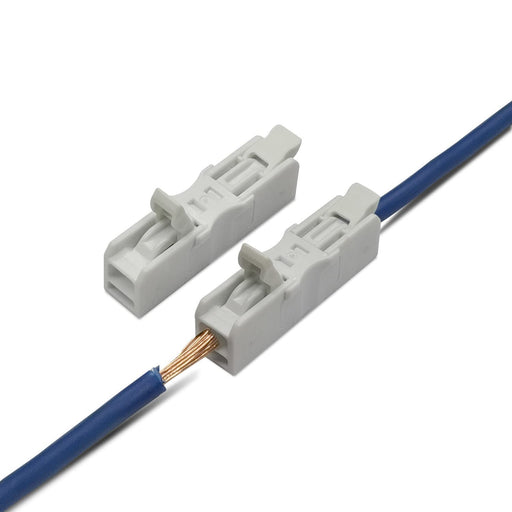
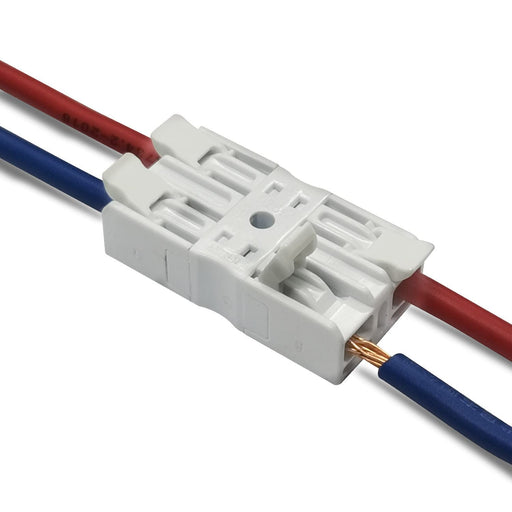
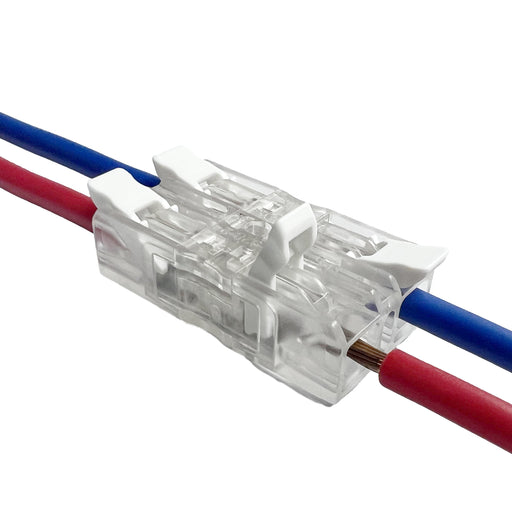
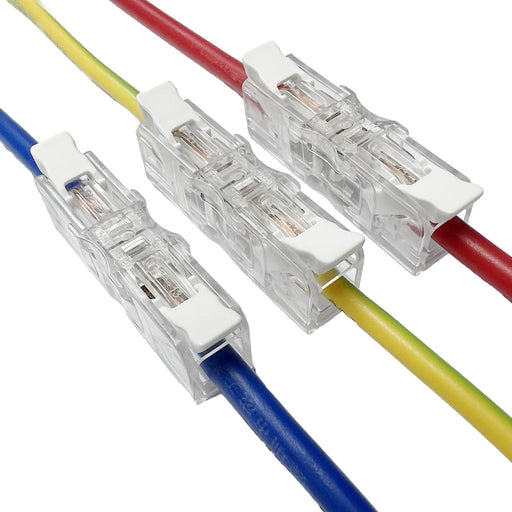
Inline lever wire connectors are the right tool for this situation. Each conductor goes into its own port independently. The spring clamp secures it with defined, consistent pressure whether the wire is solid or stranded. The clear housing variant lets you confirm full insertion before closing the lever, even working overhead.


Ceiling Fan Wiring Configurations
Single Switch: Fan and Light on One Circuit
Connect the black house wire to both the black fan lead and the blue light lead together in a single multi-port connector. White to white. Ground to ground. The fan motor and light kit operate together from one wall switch.
Dual Switch: Separate Fan and Light Control
Connect the black house wire to the black fan motor lead in one connector. Connect the red house wire to the blue light kit lead in a second connector. White to white. Ground to ground. This is four independent connections in a tight space, each with the stranded-to-solid mismatch.
Remote Receiver Installation
The receiver sits in the canopy between house wiring and fan leads. It has its own input wires (to house black and white) and output wires (to fan motor and light). Follow the receiver's specific color diagram. This produces the most connections in the smallest space, which is where compact lever connectors are most useful.
Step-by-Step Ceiling Fan Wiring with Inline Lever Wire Connectors
These steps follow the dual-switch configuration as the most complete example.
Before Starting
Turn off the circuit breaker, not just the wall switch. Verify power is off with a non-contact voltage tester at the ceiling box wires. Confirm the ceiling box is fan-rated and marked for fan support. Standard light boxes cannot handle the weight or vibration of a ceiling fan.
Step 1: Prepare the Wires
Strip exactly 0.39 inches (10mm) from each conductor using a wire stripper set for the gauge. For the fine-stranded fan leads, twist the strands clockwise after stripping to consolidate them into a tight bundle. This prevents strands from spreading at the port entry.
Step 2: Connect the Ground Wires First
Join the bare copper house ground, the green fan ground, and the green bracket ground together. A three-port lever wire connector handles all three in a single unit. Also attach the ground to the mounting bracket's grounding screw.
Step 3: Connect the Neutral Wires
Connect the white house wire to the white fan lead. Lift the lever, insert the house wire fully to the internal stop, close the lever. Repeat for the fan lead. With the clear inline connector, confirm through the transparent housing that both conductors are fully seated before closing.
Step 4: Connect the Hot Wires
Dual switch: connect black house wire to black fan lead in one connector, red house wire to blue light lead in a second. Single switch: connect black house wire to both black fan lead and blue light lead together in one multi-port connector. Each conductor goes in independently. No pre-twisting. No checking whether strands got captured.
Step 5: Test Before Closing the Canopy
Restore power and test the fan and light from the wall switches. The Dicio inline connectors include test holes at the base of each port. Use a meter probe through the test hole to verify voltage at each connection without opening anything. Turn power off before tucking wires and securing the canopy.
Dicio inline lever wire connectors are UL-listed, reusable, and built for these connections.
Ceiling Fan Wiring Troubleshooting
- Fan works, light does not: the red-to-blue connection. Open it, confirm full insertion on the blue fan lead, close the lever. If made with a wire nut, replace it.
- Light works, fan does not: the black-to-black connection. If the fan hums but doesn't spin, verify the ground is solid, then investigate the motor capacitor.
- Neither circuit works: check the neutral connection first. A failed neutral cuts both circuits. Open it, restrip the fan lead to 10mm, consolidate the strands, and reinsert.
- Flickering or intermittent operation: this is a high-resistance connection under thermal load. Open the connection, inspect the conductor, restrip if there is oxidation, and remake with an inline lever connector with each wire fully inserted.
Frequently Asked Questions
What wire connectors should I use for ceiling fan wiring?
Use UL-listed inline lever wire connectors for canopy connections. They clamp each conductor independently in its own port, which handles the fine-stranded-to-solid-core mismatch better than wire nuts. For ground connections with three conductors, use a multi-port lever connector.
What are the wire colors in a ceiling fan?
Fan leads are typically black (motor hot), white (neutral), blue (light kit hot), and green or bare copper (ground). House wiring uses black for hot, white for neutral, red for a second switched hot if present, and bare copper or green for ground.
Why is my ceiling fan flickering after installation?
Flickering after installation is a high-resistance connection under load. The most common cause is a wire nut where some strands of the fine-stranded fan lead weren't captured. Open the connection, restrip to 10mm, and remake using an inline lever connector.
Can I use lever connectors instead of wire nuts in a ceiling fan?
Yes. Lever connectors are UL-listed splicing devices meeting the same NEC 110.14(B) requirements as wire nuts. They produce more consistent results on the stranded-to-solid splices in a ceiling fan canopy.
What is the correct strip length for ceiling fan wire connections?
For Dicio inline lever connectors, strip exactly 0.39 inches (10mm). Shorter and the conductor doesn't reach the internal contact surface. Longer leaves bare copper outside the housing, which violates NEC 110.3(B).
Do I need a fan-rated electrical box?
Yes. A fan-rated box is required by NEC 422.18. Standard light boxes cannot support fan weight or absorb motor vibration. Look for a box marked 'Acceptable for Fan Support' before starting any ceiling fan wiring project.
Ceiling Fan Wiring That Stays Reliable
The wire color connections in ceiling fan wiring are not complicated. The part that creates callbacks is the connection quality at the canopy: fine-stranded fan leads meeting solid-core house wiring in a tight space. Inline lever wire connectors remove the variables that make wire nuts unreliable in that specific scenario. Each conductor goes in independently, the clamp applies consistent pressure, and the clear housing confirms insertion before the lever closes.
For a deeper look at how inline lever connectors work across all applications, wire gauge ranges, and NEC code requirements, see the complete inline lever wire connector installation guide.
UL-listed, reusable, and built for stranded-to-solid connections.
Featured collection
-
Original price $13.99 - Original price $58.99Original price $13.99 - Original price $58.99Original price $13.99$11.99 - $52.00$11.99 - $52.00Current price $11.99
Inline Lever Wire Connector Nuts [White]
Dicio ConnectorsIn stockProduct Features Elegant White Design: The Dicio inline connectors feature a pristine white body, seamlessly complementing modern designs and pr...
View full detailsOriginal price $13.99 - Original price $58.99Original price $13.99 - Original price $58.99Original price $13.99$11.99 - $52.00$11.99 - $52.00Current price $11.99Save up to 12% -
Original price $8.99 - Original price $43.99Original price $8.99 - Original price $43.99Original price $8.99$6.99 - $38.99$6.99 - $38.99Current price $6.99
Inline Wire Connectors – Clear, Tool-Free, UL-Listed, 22–14 AWG | Dicio
Dicio ConnectorsIn stockDicio’s clear inline connectors make wiring clean and simple. Built for 22–14 AWG copper wires, these compact, tool-free splice caps feature a tra...
View full detailsOriginal price $8.99 - Original price $43.99Original price $8.99 - Original price $43.99Original price $8.99$6.99 - $38.99$6.99 - $38.99Current price $6.99Save up to 11% -

 Original price $309.99 - Original price $309.99Original price$309.99$309.99 - $309.99Current price $309.99
Dicio White Inline Lever Wire Connectors 6-Port 24-12 AWG | 500 PCS/Box | 928_3_white
Dicio ConnectorsIn stockDicio White Inline Lever Wire Connectors are designed for quick, secure, and reliable inline wire splicing in residential, commercial, lighting, ju...
View full detailsOriginal price $309.99 - Original price $309.99Original price$309.99$309.99 - $309.99Current price $309.99 -

 Original price $399.99 - Original price $399.99Original price$399.99$399.99 - $399.99Current price $399.99
Dicio White Inline Lever Wire Connectors 4-Port 24-12 AWG | 1000 PCS/Box | 928_2_white
Dicio ConnectorsIn stockDicio White Inline Lever Wire Connectors are designed for quick, secure, and reliable inline wire splicing in residential, commercial, lighting, ju...
View full detailsOriginal price $399.99 - Original price $399.99Original price$399.99$399.99 - $399.99Current price $399.99 -

 Original price $529.99 - Original price $529.99Original price$529.99$529.99 - $529.99Current price $529.99
Dicio White Inline Lever Wire Connectors 24-12 AWG | 2500 PCS/Box | 928_1_white
Dicio ConnectorsIn stockDicio White Inline Lever Wire Connectors are designed for quick, secure, and reliable inline wire splicing in residential, commercial, lighting, ju...
View full detailsOriginal price $529.99 - Original price $529.99Original price$529.99$529.99 - $529.99Current price $529.99