
Inline Lever Wire Connectors: Professional Installation Guide for Tool-Free Electrical Splicing
A complete professional guide to inline lever wire connectors, covering how the spring-clamp mechanism works, wire gauge compatibility, NEC code requirements, and installation techniques for LED lighting, residential, and automotive wire splicing applications. Also covers inline wire connectors, lever wire connectors, inline splice connectors, and wire splice connector options for tool-free electrical inline connector applications.
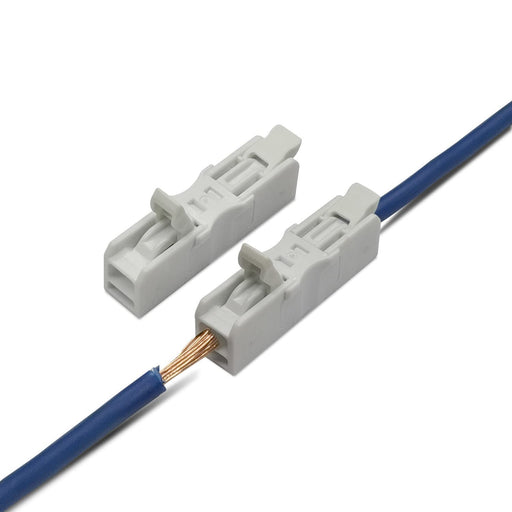
Most wire connectors are built for terminations, where conductors converge at a single point inside a junction box. Inline splicing is a different problem. Inline lever wire connectors are designed specifically for mid-run wire splice connections: the wire enters one side and continues from the other, the connection sits within the run, and you can verify full insertion through the transparent housing before the lever closes.
Wire nuts technically handle inline splicing. They also technically work when connecting stranded wire to solid, mixing different gauges, or working one-handed at the top of a ladder. There is a real difference, though, between a connection that works and one that stays reliable after hundreds of thermal cycles. That gap is where the lever mechanism earns its place.
These electrical inline connectors have become a standard fixture on commercial and residential jobs alike. This guide covers how inline lever wire connectors work, the wire gauge ranges they cover, what UL 2459 and ENEC certification means in practice, how to stay code-compliant under NEC 110.14(B) and 300.15, and the installation steps that produce consistent results on every job.
Need UL and ENEC certified inline lever wire connectors?

What Makes Inline Lever Wire Connectors Different
Standard lever connectors bring wires together at a shared termination point. Each wire enters its own port and the housing holds them all in the same clamping block, with conductors converging from multiple directions. That geometry is well suited to junction box work where three or four wires meet at a single point.
Inline lever wire connectors are built for a different geometry. The wire enters from one end and continues from the other in the same direction, staying in-line with the run. This is the configuration that matches how mid-run splicing and wire extension work in practice. The connector sits cleanly within the run rather than at a branch point. Whether you call it an inline wire connector, an inline splice connector, or an electrical inline connector, the functional principle is the same: the conductor path runs through the device, not into it from multiple angles.
When Inline Wire Splice Connectors Are the Right Tool
- Extending a wire that came up short during rough-in. Every job has this. An inline wire splice connector fixes it cleanly, without tape or a wire nut holding a pair of short tails together.
- Repairing a damaged wire mid-run. When insulation gets nicked during renovation or a wire is accidentally cut, an inline splice restores the run without replacing the full circuit.
- Connecting LED drivers to supply wiring. LED fixture leads are fine-stranded. The house wiring they connect to is solid-core. This conductor type mismatch is one of the most common places a wire nut creates a marginal connection. An inline lever connector handles it cleanly.
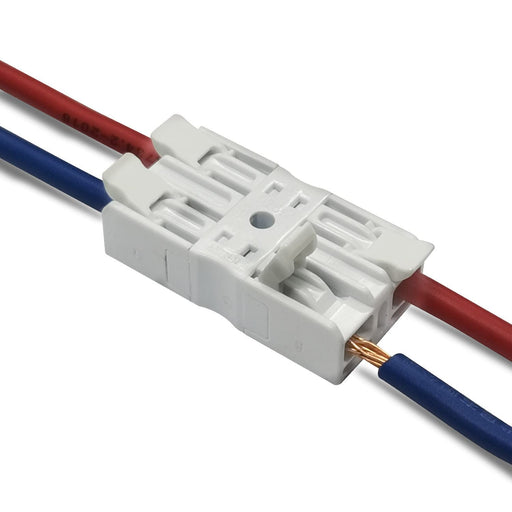
- Adding a branch from an existing run. Multi-port inline connectors let you tap an additional circuit without adding a junction box, using 2-in/2-out or 3-in/3-out configurations.
- Automotive and RV wiring. Vehicle wiring runs almost entirely inline. Inline lever wire connectors replace heat-shrink butt crimps in applications that need tool-free installation and the option to reconnect later.
- Tight spaces like ceiling fan canopies. The inline profile sits flat along the wire run and takes less room than a wire nut twisting conductors at an angle inside a confined housing.
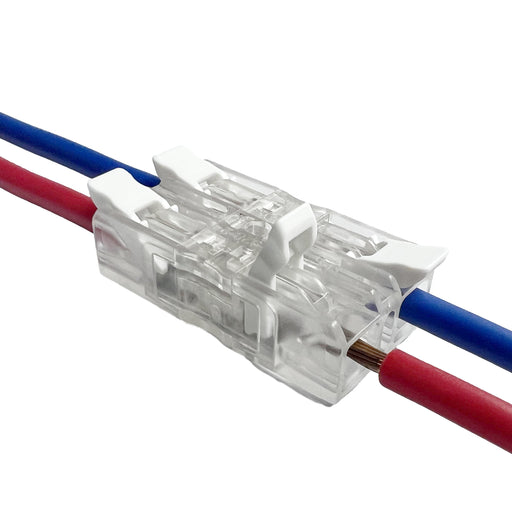
Dicio's inline connector range covers 2-port through 6-port configurations: 1-in/1-out for simple splices, 2-in/2-out and 3-in/3-out for branch point applications. Clear housing variants let you confirm wire insertion at a glance. White variants offer a cleaner finish for visible installations.

How the Lever Mechanism Works in Inline Wire Connectors
Wire nuts work through friction. You twist conductors together and the spring inside the cap maintains tension on the joint. That performs well on same-gauge, same-type conductors in ideal conditions. It becomes less consistent when conductor types differ, when one wire is fine-stranded, or when the splice ends up in a crowded box where the assembly gets pushed and jostled during device installation.
Inline lever wire connectors use a stainless steel spring clamp inside the housing. When the lever closes, it drives the clamp directly onto the conductor against a flat contact surface. The clamping pressure is constant and mechanically defined, independent of installation technique.
Independent Per-Port Clamping
Each port in an inline lever connector has its own lever and spring clamp. You insert each conductor independently, close each lever independently, and the clamp secures that wire on its own terms. Solid wire in one port and fine-stranded wire in the other presents no issue. There is no twisting of incompatible conductor types together. Each is secured by its own clamp at the same defined pressure.
This also means the clamping force does not depend on how hard you twisted during installation or whether the wire nut spring had been used before. The lever drives the clamp to the same position on every connection.
Transparent Housing for Visual Confirmation
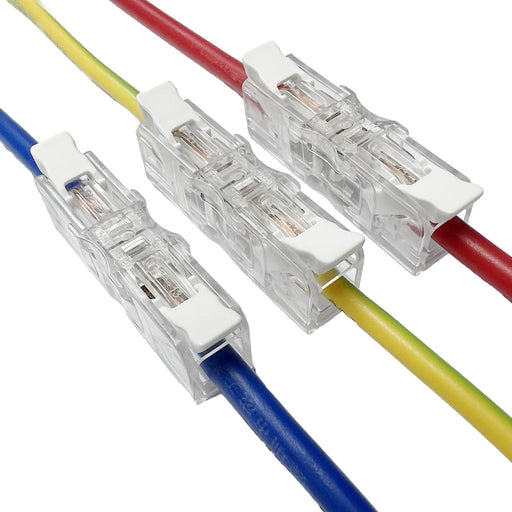
Dicio's clear inline wire connectors use a transparent housing. Before closing the lever, you can see whether the conductor has reached the internal stop. Partial insertion is the most common installation error in lever connector work. A wire that is not fully seated looks fine from the outside and may hold under a gentle pull, but it is not in full contact with the spring clamp.
Through the clear housing, you can see whether the copper has reached the end of the cavity. If it has not, you push further before closing. This matters most when working overhead or in confined spaces where watching both hands at once is difficult.
Test Holes for Live-Circuit Diagnostics
Every Dicio inline lever connector includes test holes at the base of each port. Once a circuit is energized, you can confirm voltage at the splice point by inserting a meter probe through the test hole without opening the connector or exposing any conductors. This supports staged commissioning on complex lighting circuits and simplifies fault finding when a splice needs diagnosis later.
Reusable Connections
Open the lever and the wire releases cleanly. Close it on a new conductor and the clamp resets to full pressure. The connector is designed for repeated use. Circuits get modified. LED layouts change. Automotive wiring gets reconfigured. A reusable inline lever connector saves time and wire at every revision point, compared to heat-shrink crimps that require cutting back to fresh copper or wire nuts that lose spring tension once stripped and re-twisted.
Wire Gauge Compatibility for Inline Lever Wire Connectors
Dicio inline lever wire connectors cover 24-12 AWG across the product range. That covers fine low-voltage control wiring at the small end and 20-amp residential branch circuits at the upper end, which handles the large majority of applications where inline wire splicing is the practical solution.

AWG Range by Application
- 24-18 AWG: Low-voltage control and LED strip wiring, thermostat and doorbell circuits, automotive accessory runs, and speaker wire. Typically fine-stranded conductors where per-port lever clamping offers a clear reliability advantage over twisting.
- 16-14 AWG: Residential lighting branch circuits, switch loops, and ceiling fan connections. The most common gauge for fixture and appliance wire splicing in residential work.
- 12 AWG: 20-amp branch circuits, kitchen and bathroom outlets, and higher-draw residential loads. Check the specific configuration for multi-conductor fill capacity at this gauge before installation.
Solid and Stranded Wire in the Same Port
Inline lever wire connectors accept both solid and stranded copper conductors in the same port. The spring clamp secures fine-stranded wire as reliably as solid without modification. This is the characteristic that makes inline lever connectors well suited to the most common difficult splice in residential and LED lighting work: connecting fine-stranded driver leads or fan motor leads to solid-core house wiring.
With a wire nut, that splice requires wrapping the stranded conductor around the solid before twisting, and the result often leaves some strands outside the spring. With a lever wire connector, you insert each conductor separately. The clamp does the rest.
Strip Length: The 10mm Requirement
The correct strip length for Dicio inline lever connectors is 0.39 inches (10mm). Strip shorter and the conductor end does not reach the internal contact surface. The wire may stay in the port and the lever may close, but the electrical contact is incomplete. That type of connection often passes an initial continuity check but fails under load or after thermal cycling.
Strip longer than 0.39 inches (10mm) and bare copper extends outside the housing. That creates a safety hazard and a compliance issue, since exposed conductors outside a listed enclosure violate NEC 110.3(B) installation requirements.
Use a wire stripper set for the conductor gauge and replace it when the blade begins nicking conductors. A nicked strand breaks under load, and a partial break inside a port is not visible once the lever is closed.

Dicio inline lever wire connectors cover 24-12 AWG with UL listing and ENEC certification on every unit.
NEC Code Requirements for Inline Wire Splice Connections
Selecting a certified connector covers one part of code compliance. The NEC also specifies where splices can be made, what devices are acceptable, how conductors must be prepared, and what enclosure conditions apply. These are the code sections that govern inline lever connector installations.
NEC 110.14(B): Splicing Devices Must Be Listed
NEC Section 110.14(B) requires conductors to be spliced with devices specifically identified for the application. In practice, the connector must carry independent third-party certification to a recognized standard such as UL, ETL, or CSA. The standard governing splicing wire connectors is UL486C.
This requirement exists to prevent the use of uncertified products that may appear functional but have not been tested for electrical integrity, fault current handling, or long-term performance under thermal cycling. When an inspector reviews the work, they look for the UL mark on the connector itself, not the packaging claim.
NEC 110.3(B): Installation Must Follow the Listing
Certification alone is not sufficient. NEC 110.3(B) requires that listed equipment be installed in accordance with the manufacturer's instructions. For inline lever wire connectors, the critical requirements are correct strip length, full conductor insertion to the internal stop, and staying within the rated gauge range and conductor count for the port configuration.
A lever connector can be opened for inspection and reclosed without damage. That makes it easier for an inspector to verify installation compliance non-destructively than a wire nut splice that must be cut off if there is a concern.
NEC 300.15: Splices Require an Accessible Enclosure
Section 300.15 requires that conductor splices be enclosed in a listed box or conduit body and remain accessible for future maintenance. An inline wire splice cannot be made in an open wall cavity without an accessible junction box. Every inline connector installation needs a listed enclosure with a removable cover.
Inline lever connectors are compact and sit flat along the wire run. Their defined profile fits cleanly in standard 4-inch square or single-gang boxes without the bulk that a wire nut splice creates when multiple conductors are twisted together at different angles.
NEC 314.16: Box Fill Calculations
Every conductor, fitting, and device inside a junction box contributes to the minimum required box volume under NEC 314.16. Wire gauge determines the volume allowance per conductor, and the connector's contribution depends on its type and the manufacturer's guidance.
For most residential applications using 14 AWG or 12 AWG, a standard 4-inch square junction box provides adequate fill for an inline splice. The key is confirming the calculation before installation rather than discovering a fill violation during inspection.
UL and ENEC Certification for Inline Lever Wire Connectors
Certification claims are printed on a lot of packaging. Understanding what the standards test for gives you a clear basis for assessing whether a connector will perform as stated long-term, and it is the documentation that holds up when an inspector asks for verification.
UL486C: The Standard for Splicing Wire Connectors
UL486C governs splicing wire connectors, including inline lever connectors. Testing under this standard covers the electrical and mechanical performance requirements that determine whether a wire splice connector will maintain a reliable conductive connection over its service life.
Key requirements include electrical resistance across the connection under rated load, pull-out force resistance, performance through thermal cycling, and current-carrying capacity. A connector that passes UL486C testing has demonstrated that it maintains these properties across the conditions encountered in residential and commercial installations.
When selecting any inline lever connector, look for UL certification marks printed on each individual connector, not just on packaging. Dicio inline lever connectors carry UL listing (UL 2459) and ENEC certification, with marks appearing on every individual connector. A product with a certification claim only on the box has not been independently verified to the level required by NEC 110.14(B).
UL467: Grounding and Bonding Applications
Connectors used on equipment grounding conductors need to meet UL467 in addition to general splicing connector requirements. UL467 governs grounding and bonding equipment and verifies that a connector maintains the low-resistance path required of a grounding circuit under fault conditions.
When selecting an inline wire splice connector for use on grounding conductors, verify that the product carries appropriate UL listing for grounding applications. Using a single UL-listed connector across all conductors in a box, rather than mixing certified and uncertified products, reduces the risk of using an unqualified connector on a grounding circuit.
ENEC Certification
ENEC is the European equivalent of UL certification for electrical products. Dicio connectors carry both UL and ENEC marks. Multiple independent certifications across jurisdictions confirm the product has been tested against recognized standards more than once. For contractors or distributors sourcing for projects with US and European compliance requirements, a single SKU with both marks simplifies procurement.
Spotting Real Certification vs. Packaging Claims
Uncertified and counterfeit-certified connectors are common on online marketplaces. The pattern is familiar: product listings reference UL or ENEC certification but the marks are absent on the individual connectors. Real UL certification requires the mark to be printed or molded on each connector, including the applicable standard number and the manufacturer's control number.
If those marks are not on the connector itself, the product is not certified regardless of what the listing states. Using uncertified products creates inspection failures, project delays, and liability exposure if a connection failure causes property damage.
Where Inline Lever Wire Connectors Work Best
The applications where inline lever wire connectors outperform alternatives share a few consistent characteristics: mid-run splicing geometry, often with mixed conductor types, in confined spaces where compact form and visual confirmation of the connection matter.
LED Lighting and Fixture Wiring
LED fixture wiring is where inline lever connectors have grown most rapidly in residential electrical work. The conductor type mismatch that causes problems with other connection methods is nearly guaranteed in LED work. Recessed light housings, LED strip drivers, and fixture transformers use fine-stranded output leads. The house wiring they connect to is solid-core 14 AWG or 12 AWG.
Inside a recessed can or fixture canopy, space is limited and the fixture leads are short. Making that wire splice with a wire nut, one-handed, while holding the fixture, is where marginal connections get made. Drop a strand outside the nut and the connection may pass an initial test but cause flickering or early lamp failure once the circuit cycles temperature a few times.
An inline wire splice connector removes that friction. Each conductor goes into its own port. The clear housing confirms full insertion. The compact profile fits in the canopy without bulk. And if the fixture needs replacing, you open the lever and disconnect without cutting wire.
For detailed installation guidance for this specific application, see the recessed lighting wiring guide.
Residential Junction Boxes and Wire Extensions
In residential rough-in and trim-out work, inline lever connectors are the practical choice wherever a wire needs extending mid-run or where limited wire length makes a reliable wire nut splice difficult. Older homes regularly present this condition: years of previous work leave conductors shortened inside boxes, sometimes with barely enough tail to make a connection.
A wire that cannot reach a wire nut reliably can still make a clean inline connection. Strip to 0.39 inches (10mm), insert from one side, close the lever. No awkward twisting with a short tail, no connection that sits half-engaged in the nut spring.
Automotive and RV Wire Splicing
Vehicle wiring is almost entirely inline splicing. Factory harnesses run point to point, and aftermarket accessories, repairs, and modifications add wire splice connections mid-run. The conventional approach is a heat-shrink butt crimp, which is reliable when done correctly but requires a crimping tool and is single-use by design.
Inline lever wire connectors offer a tool-free alternative that is reusable and visually verifiable. The 24-12 AWG range covers LED conversions, 12V accessory wiring, and data line splicing. The UL-rated housing material handles the temperature range typical of under-dash and cabin installations. RV wiring, which combines 12V DC and 120V AC circuits in close proximity, is fully covered within the 600V connector rating.
Low-Voltage Control and Thermostat Wiring
Thermostat wiring, HVAC controls, security system circuits, and doorbell systems involve small-gauge conductors that splice frequently. These are the applications where fine-stranded wire meets solid wire, where wire nuts are oversized, and where a compact inline wire splice connector in a small enclosure is the cleaner solution.
The 24 AWG minimum rating covers control circuits where even small butt crimps can be oversized for the conductor. For thermostat and HVAC wiring, the ability to reconnect without cutting makes troubleshooting and system changes faster.
Speaker and Audio System Wiring
Home theater and custom audio installations benefit from the reusable design when the component layout is subject to change. Speaker wire connections that need to be made and revisited during system calibration or room reconfiguration work well with a connector that opens cleanly, releases the wire without damage, and reconnects reliably. The low voltage and fine gauge of speaker wire also makes wire nuts a poor fit in terms of both connector size and connection quality.
Step-by-Step Installation Guide for Inline Lever Wire Connectors
Correct installation is as important as selecting the right connector. A UL-listed inline lever connector installed incorrectly still produces a marginal connection. These steps apply to all Dicio inline connector configurations.

Before You Start
Verify power is off before handling any conductors. Test with a non-contact voltage tester at the splice location, not only at the breaker. For LED and low-voltage work, confirm the transformer or driver is disconnected. Check that the connector size is appropriate for your conductor gauge and that the port count matches the configuration you need.
Step 1: Prepare the Wire
Strip exactly 0.39 inches (10mm) of insulation from each conductor using a wire stripper set for the gauge. Inspect the exposed copper: any nicked or broken strands should be cut back to clean copper and the wire stripped again. Trim the stripped end cleanly and perpendicular to the conductor axis.
For stranded wire, twist the strands lightly clockwise to consolidate them into a tight bundle. This prevents strands from spreading at the port entry, which is one of the more common causes of partial insertion in inline lever connector installations.
Step 2: Open the Lever
Lift each lever to the 90-degree open position before inserting the wire. The lever should open freely and remain at 90 degrees without being held. If a lever feels stiff or will not stay open, check for housing damage and confirm the connector is sized for the conductor gauge. Do not attempt to insert a wire into a partially open port.
Step 3: Insert the Wire
Push each stripped conductor fully into its port until it meets the internal stop. For clear housing connectors, confirm through the transparent casing that the copper end has reached the back of the cavity before closing the lever. The wire should be fully inserted with no bare copper visible outside the housing.
Insert one conductor at a time. On multi-port configurations, complete each port independently.
Step 4: Close the Lever
Push each lever firmly down to the closed position. You should feel and hear a click as the lever engages. If the lever closes without resistance or feels loose, the wire may not be fully seated. Open the lever, confirm full insertion, and close again.
After closing, pull each wire with moderate force to confirm it is held. The spring clamp should hold against a firm tug without movement. If a wire releases under light pressure, it was not fully inserted or the conductor gauge is outside the connector's rated range.
Step 5: Test the Connection
Use the test hole at the base of each port to verify voltage once the circuit is energized. Insert a meter probe through the test hole to confirm the expected reading without opening the lever or exposing conductors. On multi-port configurations, test each circuit independently before closing the junction box cover.
Inline Lever Wire Connectors vs Wire Nuts
Wire nuts are the established standard in US residential electrical work, and the comparison between lever wire connectors and wire nuts runs through most electrician trade communities. Both have valid applications. The differences are consistent enough to be useful for deciding which tool fits which job.
Lever wire connectors have built strong adoption across professional electrical work over the past two decades. Contractors who already use WAGO lever connectors on multi-conductor terminations will recognize the same spring-clamp operating principle applied here to the inline splice geometry. The core mechanics are the same; the form factor is optimized for mid-run connections rather than junction box convergence points.
Installation Speed
Inline lever wire connectors are faster on most connections. Lift, insert, close. There is no twisting, no checking whether the nut is tight enough, no second attempt when a strand slips. On a job with many fixture connections or junction box splices, the time difference per connection is small but compounds across a full install day.
The speed advantage is most pronounced with mixed conductor types. Connecting a fine-stranded LED driver lead to solid-core house wiring with a wire nut requires more care and more time than the same wire splice with a lever connector, where each conductor goes in independently regardless of type.
Connection Reliability and Verifiability
Wire nuts rely on the installer to apply consistent twisting force and use the correct size for the conductor combination. These are variables. Lever connectors apply a fixed clamp force to each conductor independently, with no dependence on technique beyond correct insertion depth. The clear housing confirms that insertion before the lever closes.
The test hole provides a verification option that wire nuts cannot offer. With a wire nut, confirming a live connection requires pulling the nut off or probing through the insulation. With an inline lever connector, you check the test hole.
Reusability
Wire nuts are technically reusable but practically single-use once conductors have been twisted into them. The spring compresses and the wire ends bend, so removal and reinstallation produces a weaker connection. Inline lever wire connectors are designed for repeated opening and reconnection without losing clamp performance.
Cost Comparison
Wire nuts cost less per unit. Lever connectors cost more upfront. The comparison shifts when you factor in installation time, the risk of callbacks from marginal wire nut connections on difficult conductor combinations, and the cost of a service call to find and repair a failed splice. For simple same-gauge solid wire connections in a standard box, wire nuts remain a reasonable choice. For fine-stranded connections, mixed gauges, confined spaces, or any installation where reusability matters, inline lever connectors are more cost-effective across the job lifecycle.
Space in the Box
Lever connectors have a compact, defined profile. Wire nut splices can be bulky in a box when multiple conductors are twisted together at different angles. In tight junction boxes, the predictable shape of an inline lever connector makes fill calculations more reliable and makes the box easier to close without disturbing the connections.
Troubleshooting Inline Lever Wire Connector Problems
Most failures with inline lever connectors trace back to one of a few installation errors. Identifying which one applies saves time on the diagnosis.
Wire Releases Under Load or Vibration
If a conductor pulls out or releases under vibration after installation, it was not fully inserted before the lever was closed. Open the lever, confirm the strip length is 0.39 inches (10mm), reinsert until the conductor reaches the internal stop, and close the lever. If the wire repeatedly fails to stay in, check that the gauge is within the connector's rated range and that stranded conductors were twisted tightly before insertion.
High Resistance or Voltage Drop at the Connection
A connection that shows elevated resistance or causes visible voltage drop downstream indicates partial insertion. The conductor is in the port but not in full contact with the spring clamp. Open the lever, confirm the copper is at the internal stop through the clear housing, and reclose. If the issue continues on a stranded wire, inspect for nicked or broken strands that reduce the effective conductor cross-section at the contact point.
Lever Will Not Close or Does Not Click
If a lever resists closing or does not produce a click, the wire may be over-stripped. Excess bare copper at the port entry can interfere with the closing mechanism. Trim the conductor back to exactly 0.39 inches (10mm) and reinsert. Alternatively, the conductor gauge may be at the upper limit of the connector's range and the clamp is engaging before the lever reaches the closed position. Confirm the connector model is correct for the wire gauge.
Intermittent Connection
An intermittent connection that varies with temperature suggests the conductor is at the edge of acceptable contact area inside the clamp. This can happen when a stranded wire was not fully consolidated before insertion and some strands are only partially clamped. Open the connector, inspect the conductor end, trim back to clean copper if needed, twist the strands tightly, and reinsert to full depth.
Frequently Asked Questions
What is the difference between an inline wire connector and a standard lever connector?
A standard lever connector brings wires together at a central termination point, with conductors entering from different directions. An inline lever wire connector is designed for in-line wire splicing, where the wire enters one side and continues from the other. Inline connectors are the correct tool for mid-run splices, wire extensions, and any connection where the wire path runs through the connector rather than converging on it.
What wire gauges do Dicio inline lever wire connectors accept?
Dicio inline lever connectors cover 24-12 AWG across the product range. This includes fine low-voltage and LED wiring at the small end and 20-amp residential branch circuit wire at the upper end. Both solid and stranded copper conductors are compatible in the same port.
Are inline lever wire connectors NEC-compliant for residential electrical work?
When installed per the manufacturer's instructions and enclosed in a listed, accessible enclosure under NEC 300.15, yes. NEC 110.14(B) requires listed splicing devices, and Dicio inline lever connectors carry UL listing and ENEC certification, with marks on every individual connector. Correct strip length of 0.39 inches (10mm) and staying within rated conductor count and gauge ranges are required for NEC 110.3(B) compliance. Always verify that the specific connector model and application meet local inspection requirements.
Can I use inline lever connectors on grounding conductors?
Connectors used on equipment grounding conductors should carry UL467 certification in addition to general splicing connector listing. Check the product specification for grounding circuit suitability before installation. Using appropriately certified connectors across line, neutral, and ground conductors in the same box simplifies compliance and inspection.
How many wires can an inline lever connector hold?
That depends on the port configuration. Dicio inline connectors are available from 2-port through 6-port. The 2-port handles a 1-in/1-out wire splice. Multi-port versions support 2-in/2-out and 3-in/3-out configurations for branch point applications. Always check the fill capacity for your specific conductor gauge, as larger gauges reduce the number of conductors the connector can accommodate.
Are inline lever wire connectors reusable?
Yes. Open the lever and the wire releases cleanly. Close it on a new conductor and the clamp resets. Dicio inline lever connectors are designed for repeated use without losing clamp performance, which makes them well suited to LED installations, automotive wiring, and any application where connections may need to be revisited.
Do inline lever connectors work with both solid and stranded wire?
Yes. The spring clamp secures both solid and stranded copper conductors. Each port handles its conductor independently, so solid wire in one port and stranded wire in the other is not an issue. For fine-stranded wire, twist the strands clockwise before insertion to consolidate them into a clean bundle.
What is the correct strip length for inline lever connectors?
The required strip length is 0.39 inches (10mm). Shorter than this and the conductor does not reach the internal contact surface, resulting in a high-resistance partial connection. Longer than this leaves bare copper outside the housing, which is a safety hazard and a violation of NEC 110.3(B).
Are inline lever wire connectors suitable for automotive wiring?
Yes. The 24-12 AWG range covers the conductor gauges used in most automotive and RV wiring, from 12V LED and accessory circuits to data and control wiring. The housing material is rated across the temperature range typical of under-dash and cabin environments. The reusable design is a practical advantage in automotive work where wiring is frequently reconfigured.
What is the voltage rating for Dicio inline lever wire connectors?
Dicio inline lever wire connectors are rated for 600V, covering both standard 120V residential circuits and low-voltage applications from 12V upward across the full range of inline splicing applications.
How do inline lever connectors compare to WAGO lever connectors?
WAGO lever connectors are well established in the multi-conductor termination category and helped define the spring-clamp lever mechanism as a trade standard. Inline lever wire connectors apply the same fundamental spring-clamp principle to the inline splice geometry, optimized for mid-run connections where the wire path runs through rather than converging on it. The operating principle, certified products, and tool-free installation approach are consistent across both connector types.
Building Reliable Inline Wire Splice Connections
Inline lever wire connectors solve a specific problem that wire nuts handle inconsistently: mid-run wire splicing with mixed conductor types, in confined spaces, where the connection needs to be verifiable and potentially reopened later. For LED lighting, residential wire extensions, automotive wiring, and low-voltage control circuits, the combination of per-port lever clamping, transparent housing, and compact inline geometry produces a more consistent result.
The variables that determine connection quality do not change with the connector type. Strip length must be 0.39 inches (10mm). The conductor must be fully inserted to the internal stop. The connector must be rated for the gauge and application. These are the details that separate connections that stay reliable from ones that fail after thermal cycling begins.
Dicio inline lever wire connectors carry UL listing (UL 2459) and ENEC certification, are reusable, and are available in 2-port through 6-port configurations to cover simple wire extensions through multi-branch inline splice applications. Certifications are marked on every individual connector. Specs are documented. Installation guidance is included with every product.
Ready to upgrade your inline wire splice connections?
Featured collection
-
Original price $13.99 - Original price $58.99Original price $13.99 - Original price $58.99Original price $13.99$11.99 - $52.00$11.99 - $52.00Current price $11.99
Inline Lever Wire Connector Nuts [White]
Dicio ConnectorsIn stockProduct Features Elegant White Design: The Dicio inline connectors feature a pristine white body, seamlessly complementing modern designs and pr...
View full detailsOriginal price $13.99 - Original price $58.99Original price $13.99 - Original price $58.99Original price $13.99$11.99 - $52.00$11.99 - $52.00Current price $11.99Save up to 12% -
Original price $8.99 - Original price $43.99Original price $8.99 - Original price $43.99Original price $8.99$6.99 - $38.99$6.99 - $38.99Current price $6.99
Inline Wire Connectors – Clear, Tool-Free, UL-Listed, 22–14 AWG | Dicio
Dicio ConnectorsIn stockDicio’s clear inline connectors make wiring clean and simple. Built for 22–14 AWG copper wires, these compact, tool-free splice caps feature a tra...
View full detailsOriginal price $8.99 - Original price $43.99Original price $8.99 - Original price $43.99Original price $8.99$6.99 - $38.99$6.99 - $38.99Current price $6.99Save up to 11% -

 Original price $309.99 - Original price $309.99Original price$309.99$309.99 - $309.99Current price $309.99
Dicio White Inline Lever Wire Connectors 6-Port 24-12 AWG | 500 PCS/Box | 928_3_white
Dicio ConnectorsIn stockDicio White Inline Lever Wire Connectors are designed for quick, secure, and reliable inline wire splicing in residential, commercial, lighting, ju...
View full detailsOriginal price $309.99 - Original price $309.99Original price$309.99$309.99 - $309.99Current price $309.99 -

 Original price $399.99 - Original price $399.99Original price$399.99$399.99 - $399.99Current price $399.99
Dicio White Inline Lever Wire Connectors 4-Port 24-12 AWG | 1000 PCS/Box | 928_2_white
Dicio ConnectorsIn stockDicio White Inline Lever Wire Connectors are designed for quick, secure, and reliable inline wire splicing in residential, commercial, lighting, ju...
View full detailsOriginal price $399.99 - Original price $399.99Original price$399.99$399.99 - $399.99Current price $399.99 -

 Original price $529.99 - Original price $529.99Original price$529.99$529.99 - $529.99Current price $529.99
Dicio White Inline Lever Wire Connectors 24-12 AWG | 2500 PCS/Box | 928_1_white
Dicio ConnectorsIn stockDicio White Inline Lever Wire Connectors are designed for quick, secure, and reliable inline wire splicing in residential, commercial, lighting, ju...
View full detailsOriginal price $529.99 - Original price $529.99Original price$529.99$529.99 - $529.99Current price $529.99