
Landscape Lighting Wire Connections: Waterproof, Direct-Burial & Low-Voltage Splicing Guide
Quick answer: Splice low-voltage landscape lighting wire with a sealed, silicone- or gel-filled connector that is listed for wet locations and for direct burial, then bury the cable at least 6 inches deep in ordinary soil. A splice made this way does not need a junction box under NEC 300.5(E), as long as the connector is listed for the use. Standard wire nuts and tape fail in the ground, so keep them out of the yard entirely.
This guide covers how a low-voltage landscape lighting system is wired, what the NEC asks for at 30 volts and below, which waterproof wire connectors work for direct-burial splices, how to make a splice that lasts, burial depths, common mistakes, and how to pick connectors for a crew. If you already know what you need, see Dicio's waterproof landscape wire connectors, the 1,000-piece R3 contractor box, or request a free 5-piece sample.
How a Low-Voltage Landscape Lighting System Is Wired
Most residential landscape lighting runs at 12 to 15 volts. A transformer (power unit) plugs into or is wired to a 120 V outdoor circuit and steps the voltage down. From the transformer, direct-burial landscape cable runs out to the fixtures, and every fixture lead is spliced onto that cable. On a typical yard that means dozens of splices, almost all of them in soil, mulch or a valve box.
The 120 V side and the 12 V side are different jobs
The primary side, from the panel to the transformer, is ordinary branch-circuit wiring with its own rules for boxes, GFCI protection and burial depth. The secondary side, from the transformer to the fixtures, is the low-voltage system. This guide is about the secondary side, where the splices are.
Home runs, hubs and T-connections
Installers lay out the secondary three common ways: a daisy chain, where fixtures tap one cable in sequence; a hub, where several fixtures meet at one splice point; and a T-method, where a feed cable runs to the middle of a group and branches both ways. Each layout changes how many conductors land in one splice, which is what decides the connector size.

Why the splice is the weak point
Low voltage does not mean low stakes. At 12 V, a small rise in resistance at a corroded splice shows up as dim or flickering lamps down the line. Water gets into an unsealed splice through the end of the connector and wicks along stranded copper. Once the copper turns green, the only fix is to dig up the splice and cut back to clean wire.
What the NEC Requires for Landscape Lighting Splices
Check the NEC edition and local amendments your jurisdiction has adopted. The rules below are the ones inspectors usually ask about for landscape lighting.
- Article 411 (lighting systems operating at 30 volts or less): 411.1 sets the scope at 30 V ac or 60 V dc, dropping to 15 V ac or 30 V dc where wet contact is likely. 411.4 requires the system to be listed as a whole, or assembled from individually listed parts.
- 110.14(B): splices must be made with devices identified for the use, and connectors or splicing means on conductors for direct burial must be listed for that use.
- 300.5(E): direct-buried conductors or cables may be spliced or tapped without a splice box, provided the splice is made in accordance with 110.14(B). That is the rule behind a buried splice with no box.
- Table 300.5: sets minimum cover. Circuits for landscape lighting and irrigation control limited to 30 volts, installed with Type UF or other identified cable, have their own column (see the burial depth section below).
- 210.8(A)(3) and 406.9(B)(1): at a dwelling, the outdoor receptacle the transformer plugs into needs GFCI protection and a weatherproof in-use cover.
- Article 680: lighting near pools, spas and fountains follows Article 680, not just Article 411.
On the product side, UL 486G is the standard for sealed twist-on connectors. Its scope allows direct burial without an enclosure for low-voltage lighting and Class 2 and Class 3 circuits. Our UL 486 standards guide explains how UL 486G differs from UL 486D and how to read the listing on a package.
Waterproof Wire Connectors for Landscape Lighting: The Options
Silicone-filled twist-on connectors
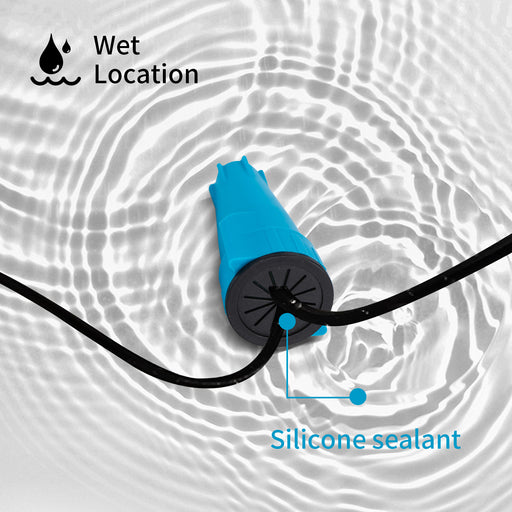
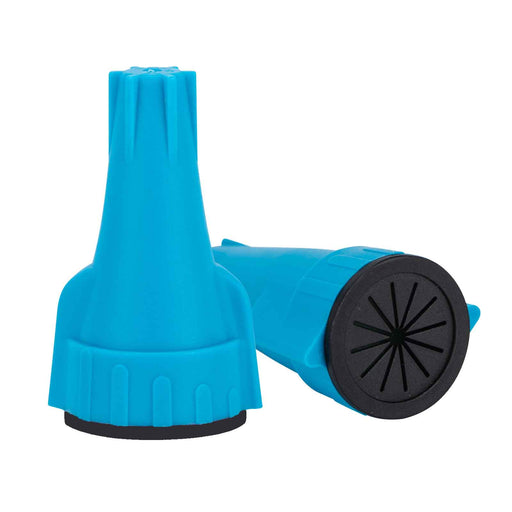
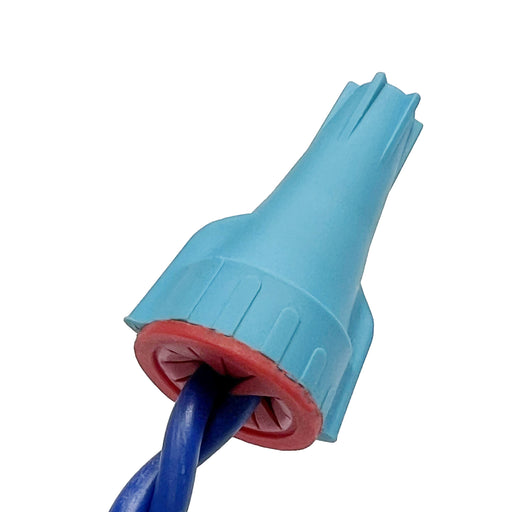
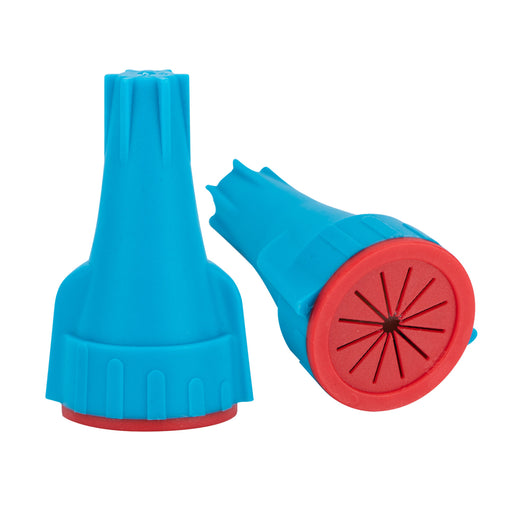
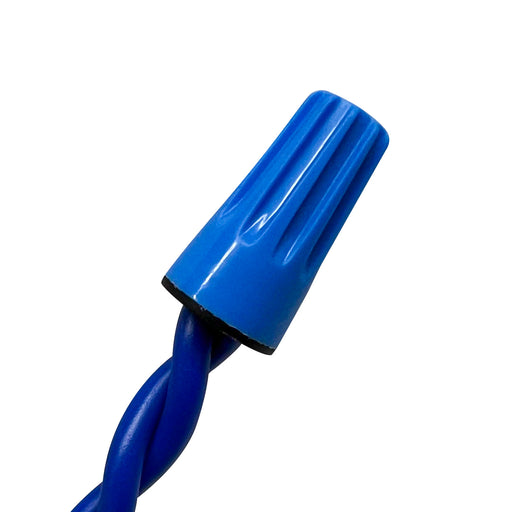
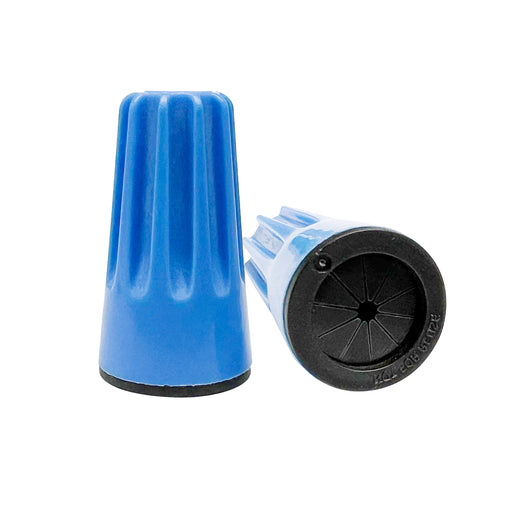
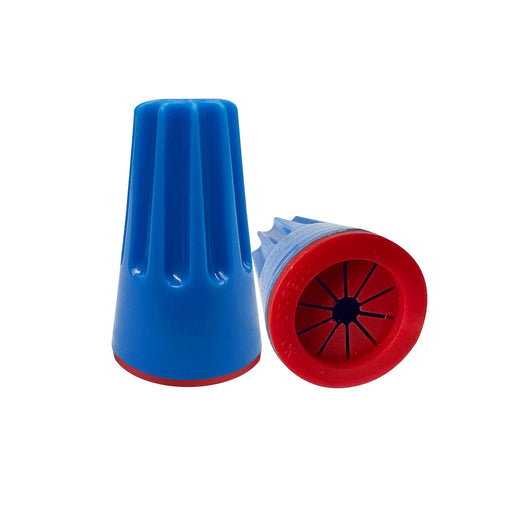
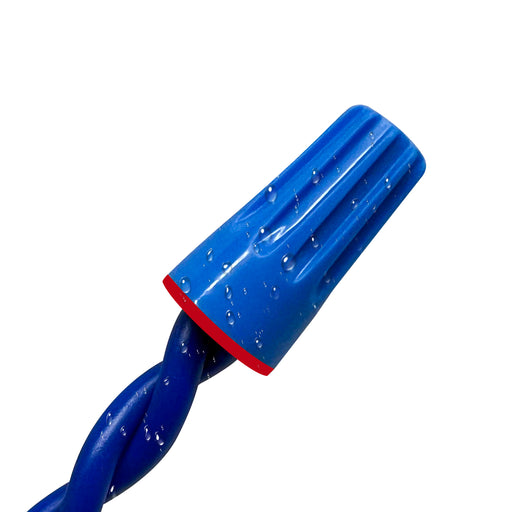
A twist-on connector with a spring inside a shell pre-filled with silicone sealant. You twist it onto the conductors like a standard wire nut, and the sealant closes around the wire. This is the most common splice for landscape lighting and irrigation because it is fast, needs no tools and holds several conductors. Dicio's waterproof landscape connectors are this type.
Gel- or grease-filled capsules and crimp splices
Some systems use a crimp or set-screw connection pushed into a gel-filled tube or capsule. They seal well but add a step, and several need a crimp tool.
Adhesive-lined heat shrink
Dual-wall heat shrink with an adhesive lining can seal an inline splice. It needs a heat source in the field, and whether it is acceptable for direct burial depends on how the product is listed.
Fixture quick-connectors
Many fixtures ship with a piercing or clamp connector that taps the main cable without stripping. They are quick, but they expose copper where the teeth pierce the jacket, which is why many installers replace them with sealed splices on maintenance calls.
How to Splice Landscape Lighting Wire: Step by Step

- Turn off the transformer. Low voltage still arcs and shorts. Switch the transformer off or unplug it before working on the secondary.
- Plan the splice point. Leave enough slack in the main cable and the fixture lead to lift the splice out of the ground later, about a foot of loop on each side.
- Strip to the package length. Strip the main cable conductors and the fixture leads to the length printed on the connector package. Do not nick the strands.
- Check the combination. Count every conductor going into the splice and confirm the combination is on the package chart. A 12 AWG cable conductor plus an 18 AWG fixture lead is a common pair.
- Twist the conductors together. Hold the stripped ends parallel and pre-twist them clockwise so the stranded fixture lead wraps the heavier conductor.
- Twist on the filled connector. Push the conductors into the sealant and turn the connector clockwise until it is tight and the insulation below the skirt starts to twist. Sealant squeezing out at the base is normal.
- Tug-test every conductor. Pull each wire individually. None should move.
- Point the connector down and bury it. Lay the splice with the opening facing down so water drains away from it, then backfill to the depth in the next section. Do not reuse a filled connector after removing it.

For more detail on twist-on technique and connector sizing, see our waterproof wire connector installation guide.
Burial Depth for Landscape Lighting Wire
Table 300.5 gives minimum cover, measured from the top of the cable to finished grade. For circuits limited to 30 volts that are installed with Type UF or other identified cable, the 2017 NEC lists:
| Location | Minimum cover, 30 V landscape and irrigation circuits |
|---|---|
| Most locations (lawns, beds, open yard) | 6 in. |
| One- and two-family dwelling driveways and outdoor parking areas | 18 in. |
| Streets, highways, roads, alleys, other driveways and parking lots | 24 in. |
A table note allows less cover where the installation instructions of a listed low-voltage lighting system say so, and another covers pool, spa and fountain lighting in a nonmetallic raceway. Check the edition adopted in your area. The 120 V supply to the transformer has deeper requirements.

Splices go in the same trench at the same depth as the cable. Under a path or a driveway, sleeve the cable in conduit so the splice can stay in open soil where it can be reached. Irrigation valve wiring follows the same column; our irrigation wire connection guide covers valve splices.

Sizing: Dicio Waterproof Landscape Connectors
Size by the wire range and the combination chart on the package. The table uses only what Dicio's product pages state.
| Product | Wire range | Pack | Price | Stated rating |
|---|---|---|---|---|
| Waterproof Landscape Wire Connectors, Medium (R3) | 20–12 AWG | 5 to 1,000 pcs | $7.99 (5 pcs) to $429.99 (1,000 pcs) | UL listed, silicone-filled |
| R3 contractor box | 20–12 AWG | 1,000 pcs | $429.99 | Up to 600 V |
| R6 wire nuts | 20–8 AWG | 1,000 pcs | $809.99 | UL listed |
| P3W small | 22–14 AWG | 10,000 pcs | $999.99 | UL listed, 32 A |
| P4W wire nuts | 22–8 AWG | 5,000 pcs | $669.99 | 600 V, 32 A |
Count every conductor in the splice, including fixture leads, and stay within the minimum and maximum combinations on the package. On a hub with more conductors than one connector allows, split the splice or use a larger size.
Common Mistakes With Landscape Lighting Splices
Burying a standard wire nut
A dry-location wire nut has no sealant and is not listed for direct burial. Water reaches the copper within a season.
Wrapping the splice in tape
Electrical tape is not a waterproof seal. Moisture tracks under the wrap and the adhesive lets go as the ground warms and cools.
No slack at the splice
Without a loop of extra cable, the next repair means a second splice next to the first. Leave enough cable to lift the splice above ground.
Connector facing up
A connector buried with the opening up collects water against the sealant. Lay it opening-down.
Splicing at grade where it gets hit
A splice left at the surface gets cut by edgers and aerators. Bury it to the cable depth or protect it.
Mixing the 120 V and 12 V rules
The no-box allowance for listed direct-burial splices does not change how the 120 V supply to the transformer is wired. Keep the primary side in boxes and approved wiring methods.
Landscape Lighting Splice Methods Compared
| Method | Speed | Tools | Best for | Watch out for |
|---|---|---|---|---|
| Silicone-filled twist-on | Fast | None | Most fixture and hub splices | Combination chart; one-time use |
| Gel capsule with crimp | Medium | Crimp tool | Inline splices on long runs | Matching crimp and capsule size |
| Adhesive-lined heat shrink | Slow | Heat gun or torch | Single inline splices | Listing for burial; heat in the field |
| Fixture quick-connector | Fastest | None | Temporary layouts | Exposed copper at the pierce point |
| Splice in a valve box | Medium | Box, connectors | Hubs you want to reach later | Box still floods; connectors must be sealed |
How to Choose Waterproof Connectors for Landscape Lighting Crews
- Listed for the location. Look for a listing that covers wet locations and direct burial, and check the voltage on the package.
- Combination chart that matches your cable. 12 AWG and 10 AWG main runs with 18 AWG fixture leads are the usual mix. Check that pair is on the chart.
- Pack size that matches the work. A crew doing a few installs a week goes through hundreds of splices a month. Case packs cut the cost per splice. See how contractors buy connectors in bulk.
- A supplier who documents listings. Ask for the spec sheet and the listing. See how Dicio documents its approvals.
- Try before you stock the truck. A sample shows how the connector seats on your actual cable and leads.
Dicio waterproof landscape connectors
- Waterproof Landscape Wire Connectors (R3): retail packs from 5 to 1,000 pieces.
- R3 contractor box, 1,000 pcs and R6 box, 1,000 pcs for heavier conductors.
- P3W small, 10,000 pcs and P4W, 5,000 pcs for distributors and high-volume crews.
- All bulk and wholesale case packs.
- Free 5-piece R3 sample for trade buyers.
Frequently Asked Questions
Can waterproof wire nuts be buried?
Yes, if the connector is listed for direct burial. NEC 110.14(B) requires connectors on direct-burial conductors to be listed for that use, and 300.5(E) then allows the splice without a box. Check the listing and location statement on the package.
Do low voltage splices need boxes?
A direct-buried landscape lighting splice made with a connector listed for direct burial does not need a splice box under NEC 300.5(E). Splices on the 120 V side, and splices your inspector treats differently under the local code, still go in a box.
How deep do you bury landscape lighting wire?
For circuits limited to 30 volts with UF or other identified cable, Table 300.5 lists 6 inches of cover in most locations, 18 inches under one- and two-family dwelling driveways, and 24 inches under streets and commercial parking lots. Check your adopted edition.
What size waterproof connector do I need for 12/2 landscape wire?
Size by the total conductors in the splice. A 12 AWG cable conductor joined to an 18 AWG fixture lead is within the 20–12 AWG range of Dicio's R3, but confirm the exact combination on the package chart.
Can I use regular wire nuts outside?
Not in wet locations or in the ground. A standard wire nut has no sealant and is not listed for direct burial. Use a sealed connector listed for the location, or a standard connector inside an enclosure rated for it.
Are waterproof wire connectors code compliant?
They are when they are listed for the location and installed according to their instructions, as NEC 110.3(B) requires. Read the package for the listing, the location statement and the wire combinations.
How do you use waterproof wire connectors?
Strip to the package length, pre-twist the conductors, push them into the sealant and twist the connector on clockwise until tight. Tug-test each wire, then lay the splice opening-down before burying it.
Supplying Landscape and Irrigation Crews?
Landscape lighting, irrigation and electrical contractors can request a free waterproof connector sample and volume pricing through Dicio PRO, or browse the case-pack prices. Distributors and supply counters can talk to our team about stocking, spec sheets and private label.
This guide is general information based on the NEC and published UL standard scopes. Follow the code edition and local amendments adopted by your authority having jurisdiction, the lighting system's installation instructions, and the instructions on the connector package.
Featured collection
-
Original price $12.99 - Original price $25.99Original price $12.99 - Original price $25.99Original price $12.99$9.99 - $19.99$9.99 - $19.99Current price $9.99
Waterproof Landscape Wire Connectors [Large]
Dicio ConnectorsIn stockSuperior Defense for Outdoor and Irrigation Environments Model Number: R6 Certified Quality: UL Listed (UL486D), IP68 Rated Water Resistant: Si...
View full detailsOriginal price $12.99 - Original price $25.99Original price $12.99 - Original price $25.99Original price $12.99$9.99 - $19.99$9.99 - $19.99Current price $9.99Save up to 23% -
Original price $9.99 - Original price $499.99Original price $9.99 - Original price $499.99Original price $9.99$7.99 - $429.99$7.99 - $429.99Current price $7.99
Waterproof Landscape Wire Connectors [Medium]
Dicio ConnectorsIn stockDicio’s waterproof wire connectors are built to withstand the elements. Twist the wires together, insert into the pre-filled connector, and snap it...
View full detailsOriginal price $9.99 - Original price $499.99Original price $9.99 - Original price $499.99Original price $9.99$7.99 - $429.99$7.99 - $429.99Current price $7.99Save up to 14% -
Original price $11.99 - Original price $43.99Original price $11.99 - Original price $43.99Original price $11.99$9.99 - $38.90$9.99 - $38.90Current price $9.99
Waterproof Landscape Wire Connectors [Small]
Dicio ConnectorsIn stockResilient Waterproof Connectors for Ultimate Outdoor Protection Model Number: P4W Certified Quality: UL-listed (UL486G) to ensure safety and r...
View full detailsOriginal price $11.99 - Original price $43.99Original price $11.99 - Original price $43.99Original price $11.99$9.99 - $38.90$9.99 - $38.90Current price $9.99Save up to 12% -
Original price $19.99 - Original price $75.99Original price $19.99 - Original price $75.99Original price $19.99$15.99 - $69.99$15.99 - $69.99Current price $15.99
Waterproof Landscape Wire Connectors [Extra Small]
Dicio ConnectorsIn stockResilient Waterproof Connectors for Ultimate Outdoor Protection Model Number: P3W Certified Quality: UL-listed (UL486G) to ensure safety and r...
View full detailsOriginal price $19.99 - Original price $75.99Original price $19.99 - Original price $75.99Original price $19.99$15.99 - $69.99$15.99 - $69.99Current price $15.99Save up to 24% -
Original price $15.99Original price $15.99 - Original price $15.99Original price $15.99Current price $9.99$9.99 - $9.99Current price $9.99
Dicio 3:1 Heat Shrink Tubing Kit 180PC Waterproof Set
Dicio ConnectorsLow stockDicio’s 3:1 Heat Shrink Tubing Kit provides industrial-grade insulation, sealing, and protection for all your wiring needs. Designed with a double-...
View full detailsOriginal price $15.99Original price $15.99 - Original price $15.99Original price $15.99Current price $9.99$9.99 - $9.99Current price $9.99Save 38%